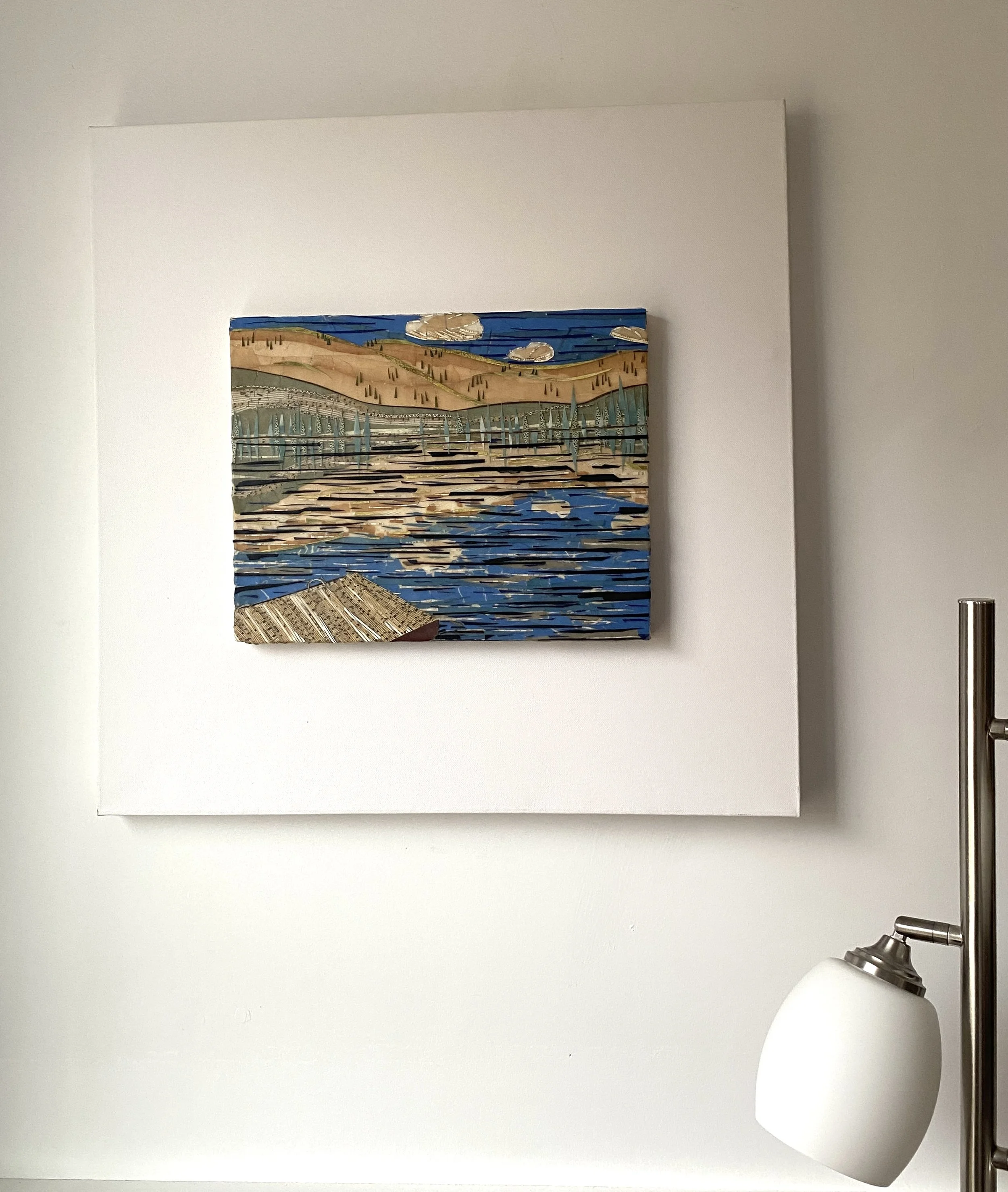
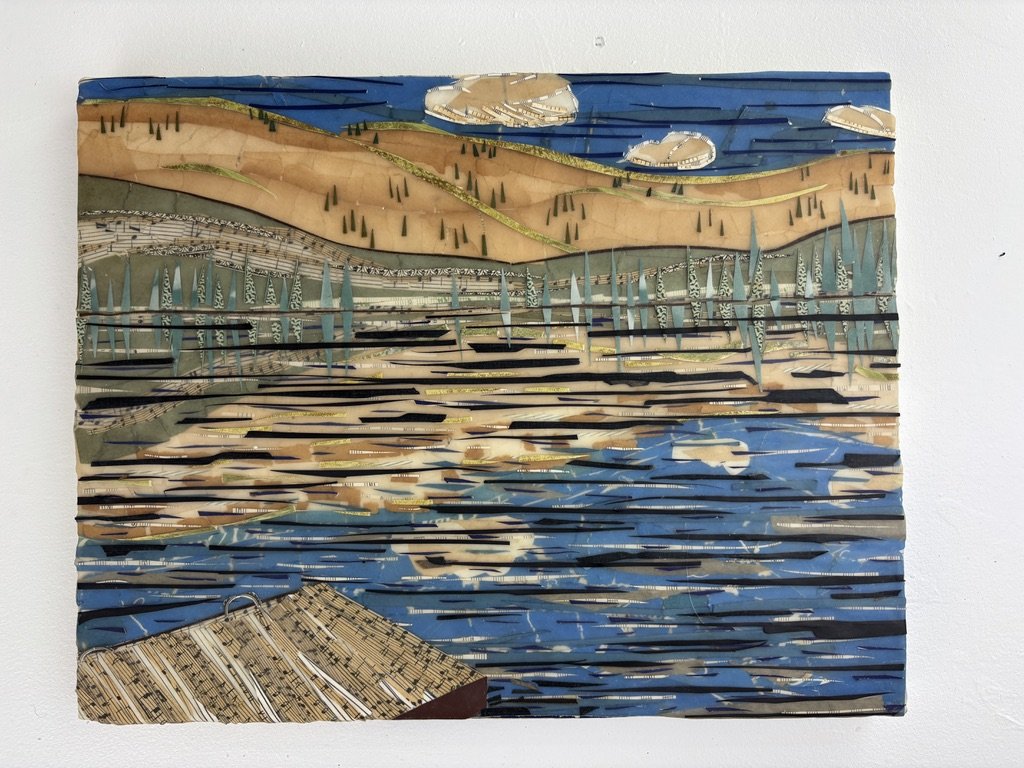
Tunes on the dock
11” X 14” x1”
Wood canvas, antique paper, non toxic white glue, acrylic finish
2024
My papier mâché works using antique sheet music seek to celebrate and repurpose the best and worst quality music from my great paper era collection of music which spans close to 300 years (1723-1972). My creative endeavours have focused on creating and celebrating language with a particular focus on universal languages. As a multi lingual and multi cultural person music was (and still is) a most tangible link to culture for me.I grew up moving every two years and although we were posted far and wide, my parents, an Irish mother from the north of Ireland and a French Canadian military man with Métis heritage, made sure we were given strong links to our mixed heritage. I also use it because the wealth of printed music from the last several centuries has become obsolete for the most part.It was collected and shared with great care and love, from one generation to another, as such the quality of the paper was essential to its longevity.The greatest paper made over the centuries was made for music, which was to pass from hand to hand to hand. I have had a great love for it and have always yearned to use it in my work as an artist and artisan.
It is important for me to honour every aspect of each piece of music I used for this work.As such, the inventory of colour resulting from age, paper composition (cotton, linen even mummy paper from the 1840’s), margins, print size, decorative whimsy and graphic patterns become components of my palette.
The many different pieces of music used in this piece are a reminder of the many many people who cherished and passed this music down through generations. The oldest paper is from 1723 and boasts a thin gold line and a soft brown fade. The greens are from a “Rag” from 1923 and a University of Torontomusic examination book from 1937The most recent paper is from 1945 and is recognized by how dark it is, discoloured by the acid content over time. The music below the big tree roots is from 1843. The work is a tapestry of time, a new composition of time and recycling of beloved artifacts. We are all soothed by music, it is a universal language of healing and wellbeing and connects us to our ancestors. This work now connects me to all those who kept their music archive, to you and to all future folk that encounter it because they will do a visual dance of discovery, and so musical magic is made.
Part of my family history goes back to a proud moment of the union of a grandfather of mine to an Algonquin woman and he helped to save their village from attack. He wrote his story on birchbark apparently and there is a song and story that authenticate this oral tradition. It is called “The legend of Cadieux”, or “La légende de Cadieux” and a statue of him since he was such a celebrity coureur de bois. Interestingly, it is clear that the process of trying to eradicate cultural heritage has a perfect example right here. The song and story tells us Cadieux married an Algonquin woman and yet the marriage documents falsify her heritage. I was always proud of knowing my paternal francophone family had been devoted to and intertwined with the Algonquin indigenous community for generations and it gave me a complex cultural background that anchored me as a child. We moved every two years because my father was a pilot in the Military. We always returned to the Canadian shield to spend our summers, from wherever we went. So the lands of clear lakes, rolling hills and beautiful rocks of the Anishinabek Nation have always felt like home to me in my core.
My deep love for the beauty of Canada and all its beautiful music travels in this piece.
May you hear music of your home and heart when you look at it.
11” X 14” x1”
Wood canvas, antique paper, non toxic white glue, acrylic finish
2024
My papier mâché works using antique sheet music seek to celebrate and repurpose the best and worst quality music from my great paper era collection of music which spans close to 300 years (1723-1972). My creative endeavours have focused on creating and celebrating language with a particular focus on universal languages. As a multi lingual and multi cultural person music was (and still is) a most tangible link to culture for me.I grew up moving every two years and although we were posted far and wide, my parents, an Irish mother from the north of Ireland and a French Canadian military man with Métis heritage, made sure we were given strong links to our mixed heritage. I also use it because the wealth of printed music from the last several centuries has become obsolete for the most part.It was collected and shared with great care and love, from one generation to another, as such the quality of the paper was essential to its longevity.The greatest paper made over the centuries was made for music, which was to pass from hand to hand to hand. I have had a great love for it and have always yearned to use it in my work as an artist and artisan.
It is important for me to honour every aspect of each piece of music I used for this work.As such, the inventory of colour resulting from age, paper composition (cotton, linen even mummy paper from the 1840’s), margins, print size, decorative whimsy and graphic patterns become components of my palette.
The many different pieces of music used in this piece are a reminder of the many many people who cherished and passed this music down through generations. The oldest paper is from 1723 and boasts a thin gold line and a soft brown fade. The greens are from a “Rag” from 1923 and a University of Torontomusic examination book from 1937The most recent paper is from 1945 and is recognized by how dark it is, discoloured by the acid content over time. The music below the big tree roots is from 1843. The work is a tapestry of time, a new composition of time and recycling of beloved artifacts. We are all soothed by music, it is a universal language of healing and wellbeing and connects us to our ancestors. This work now connects me to all those who kept their music archive, to you and to all future folk that encounter it because they will do a visual dance of discovery, and so musical magic is made.
Part of my family history goes back to a proud moment of the union of a grandfather of mine to an Algonquin woman and he helped to save their village from attack. He wrote his story on birchbark apparently and there is a song and story that authenticate this oral tradition. It is called “The legend of Cadieux”, or “La légende de Cadieux” and a statue of him since he was such a celebrity coureur de bois. Interestingly, it is clear that the process of trying to eradicate cultural heritage has a perfect example right here. The song and story tells us Cadieux married an Algonquin woman and yet the marriage documents falsify her heritage. I was always proud of knowing my paternal francophone family had been devoted to and intertwined with the Algonquin indigenous community for generations and it gave me a complex cultural background that anchored me as a child. We moved every two years because my father was a pilot in the Military. We always returned to the Canadian shield to spend our summers, from wherever we went. So the lands of clear lakes, rolling hills and beautiful rocks of the Anishinabek Nation have always felt like home to me in my core.
My deep love for the beauty of Canada and all its beautiful music travels in this piece.
May you hear music of your home and heart when you look at it.